> ## Documentation Index
> Fetch the complete documentation index at: https://docs.evermind.ai/llms.txt
> Use this file to discover all available pages before exploring further.
# Memory Lifecycle
> From passive storage to a dynamic, living memory operating system
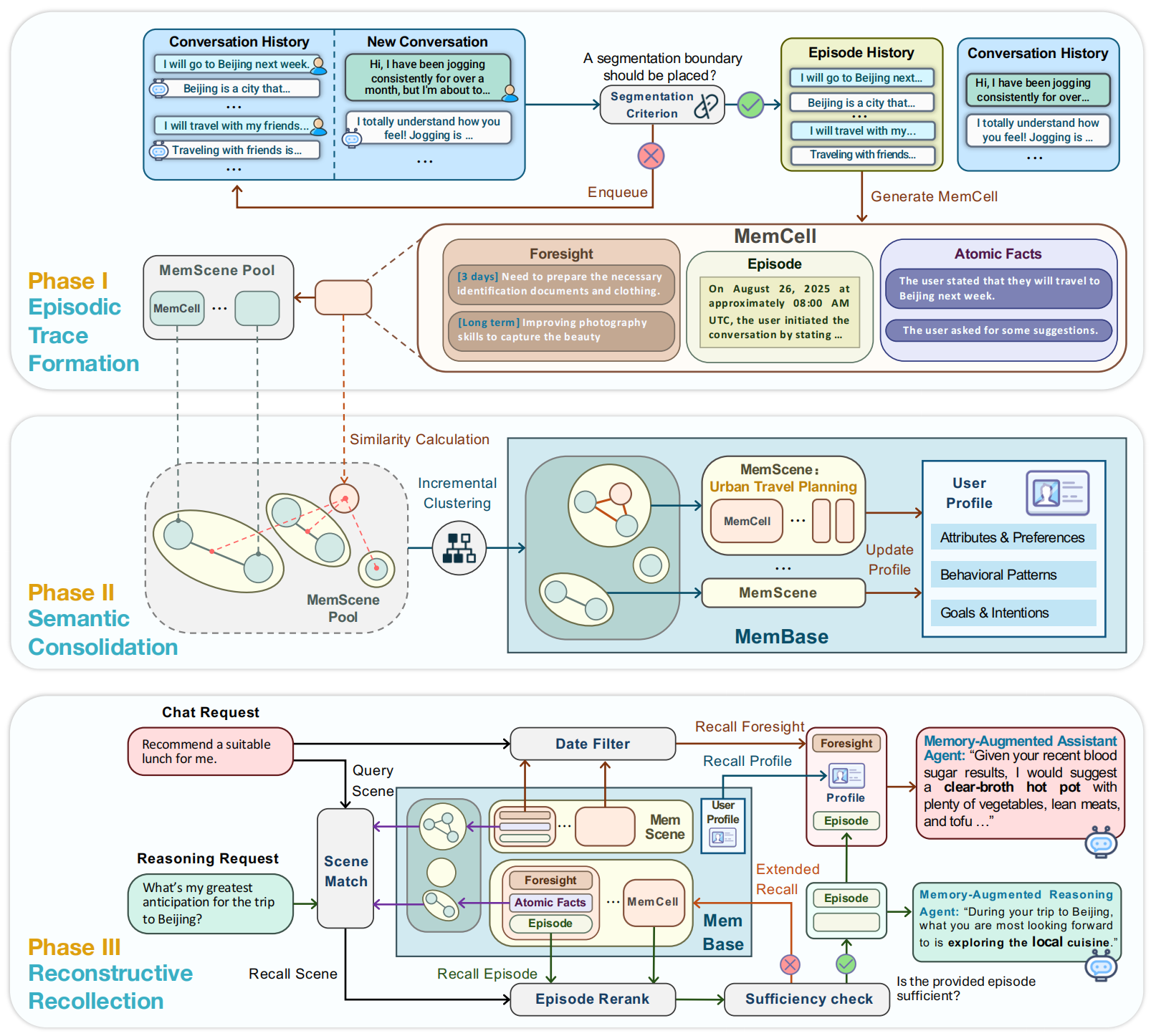
Traditional RAG (Retrieval-Augmented Generation) systems often treat memory as a static database—a place where data goes to rest until it is searched. **EverOS** reimagines memory as a dynamic, living lifecycle, inspired by the biological formation of engrams in the human brain.
 ## The Biological Inspiration
In neuroscience, a memory is not a single file stored in a folder. It is a process.
1. **Encoding**: Experiences are captured.
2. **Consolidation**: Experiences are stabilized and integrated into long-term knowledge during rest.
3. **Reconstruction**: Memories are actively rebuilt during recall, not just "played back."
EverOS implements this exact lifecycle for LLM Agents, allowing them to evolve over time rather than just accumulating data.
## The Three-Phase Workflow
EverOS manages memory through three continuous phases:
The system monitors the continuous stream of user interactions. Instead of storing raw logs, it segments them into discrete, meaningful events called **[MemCells](/cloud/concepts/memcell)**. This is equivalent to how you remember a "dinner party" as a distinct event, not a second-by-second transcript.
In the background, the system analyzes new MemCells. It links them to existing knowledge, updates the User Persona, and clusters related memories into **[MemScenes](/cloud/concepts/memscene)**. This transforms transient episodes into stable, long-term wisdom.
When the Agent needs to act, it doesn't just keyword-search the database. It uses **[Reconstructive Recollection](/cloud/concepts/reconstructive-recollection)** to intelligently traverse the memory graph, piecing together the exact context needed for the current task—filtering out noise and prioritizing relevance.
## The Biological Inspiration
In neuroscience, a memory is not a single file stored in a folder. It is a process.
1. **Encoding**: Experiences are captured.
2. **Consolidation**: Experiences are stabilized and integrated into long-term knowledge during rest.
3. **Reconstruction**: Memories are actively rebuilt during recall, not just "played back."
EverOS implements this exact lifecycle for LLM Agents, allowing them to evolve over time rather than just accumulating data.
## The Three-Phase Workflow
EverOS manages memory through three continuous phases:
The system monitors the continuous stream of user interactions. Instead of storing raw logs, it segments them into discrete, meaningful events called **[MemCells](/cloud/concepts/memcell)**. This is equivalent to how you remember a "dinner party" as a distinct event, not a second-by-second transcript.
In the background, the system analyzes new MemCells. It links them to existing knowledge, updates the User Persona, and clusters related memories into **[MemScenes](/cloud/concepts/memscene)**. This transforms transient episodes into stable, long-term wisdom.
When the Agent needs to act, it doesn't just keyword-search the database. It uses **[Reconstructive Recollection](/cloud/concepts/reconstructive-recollection)** to intelligently traverse the memory graph, piecing together the exact context needed for the current task—filtering out noise and prioritizing relevance.