

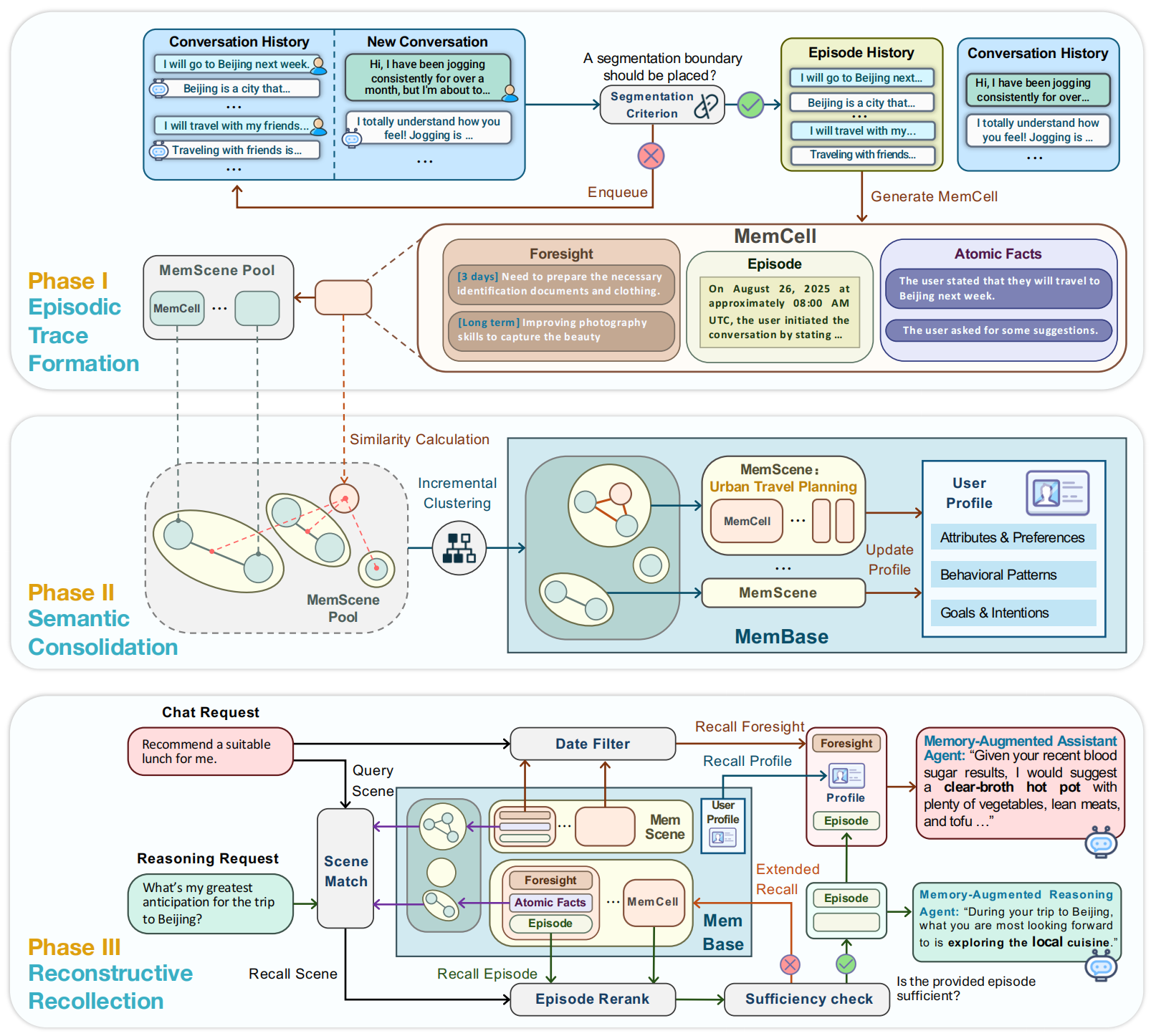
The EverOS Memory Lifecycle: Formation, Consolidation, and Recollection
The Biological Inspiration
In neuroscience, a memory is not a single file stored in a folder. It is a process.- Encoding: Experiences are captured.
- Consolidation: Experiences are stabilized and integrated into long-term knowledge during rest.
- Reconstruction: Memories are actively rebuilt during recall, not just “played back.”
The Three-Phase Workflow
EverOS manages memory through three continuous phases:1
Episodic Trace Formation (Encoding)
The system monitors the continuous stream of user interactions. Instead of storing raw logs, it segments them into discrete, meaningful events called MemCells. This is equivalent to how you remember a “dinner party” as a distinct event, not a second-by-second transcript.
2
Semantic Consolidation (Storage)
In the background, the system analyzes new MemCells. It links them to existing knowledge, updates the User Persona, and clusters related memories into MemScenes. This transforms transient episodes into stable, long-term wisdom.
3
Reconstructive Recollection (Retrieval)
When the Agent needs to act, it doesn’t just keyword-search the database. It uses Reconstructive Recollection to intelligently traverse the memory graph, piecing together the exact context needed for the current task, filtering out noise and prioritizing relevance.