

What EverOS gives your product
Self-evolving memory
Records each agent run as a Case and distills recurring Cases into reusable
Skills, so your agents get better at a task the more they run it.
User + Agent memory
Two tracks: User Memory (who the user is) and Agent Memory (what the agent
has learned). Scope by owner, type, and user / agent / app / project / session.
Remembers any format
Native multimodal: text, images, audio, docs, PDF, HTML, spreadsheets, slides,
and email become structured, searchable memory.
Precise retrieval
Keyword, vector, hybrid, or agentic search, resolving coarse Episodes down to
atomic Facts for verifiable recall instead of fuzzy summaries.
Full lifecycle control
Add, search, correct, delete, and rate individual memories. Memory is a governable
asset you control, not an append-only black box.
Memory Bank
See exactly what’s stored (profiles, episodes, agent cases and skills) in the
console, browsable by owner, type, and time.
Cloud and open source, one API
The same API on managed Cloud and self-hosted (Apache-2.0). Move between them for
compliance without rewriting code.
How EverOS works (a quick glance)
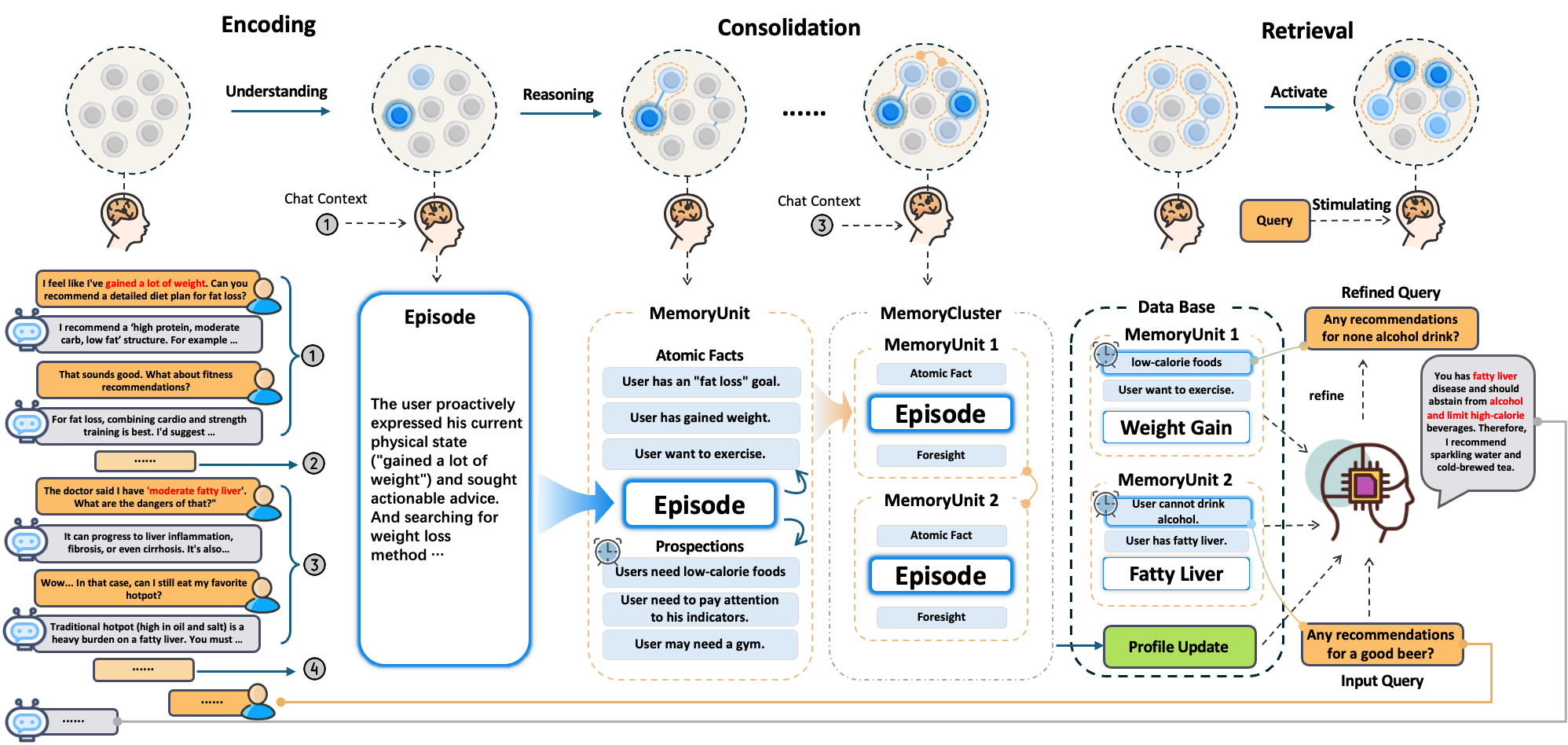
- Episodic Trace Formation: EverOS monitors the continuous dialogue stream and uses semantic boundary detection to segment interactions into coherent events.
- Structured Encoding: For each event, it synthesizes a MemCell containing a concise third-person Episode and atomic Facts.
- Semantic Consolidation: Instead of flat storage, MemCells are dynamically clustered into thematic MemScenes (e.g., “Health”, “Work”) to capture high-level contexts.
- Profile Evolution: The system continuously distills these scenes to update a structured User Profile, separating stable traits from temporary states.
- Reconstructive Recollection: Your agent retrieves context via hybrid search (BM25/vector/RRF) or Agentic Retrieval. EverOS navigates MemScenes, filters for time-valid evidence, and iterates until the retrieved context is “necessary and sufficient.”
- Grounded Reasoning: The agent uses the returned memories as grounded context to respond and plan, enabling long-horizon reasoning without replaying weeks or months of history in the prompt.
Proven on public benchmarks
- LoCoMo 93.05% · LongMemEval 83.00% · HaluMem recall 90.04% — memory accuracy and anti-hallucination
- +234.8% peak task-success lift from the self-evolving skill engine
- ~450ms P95 latency · >90% fewer tokens than full-context (about 10× lower cost)
Core memory operations
Add Memory
Extract memory from messages and interactions, across text and files.
Get Memory
Precise memory filtering based on owner, type, and metadata fields.
Search Memory
Context-aware retrieval (keyword, vector, hybrid, agentic) across every format.
Correct a Memory
Rewrite one episode’s narrative, summary, or subject when it got something wrong.
Delete by ID
Remove specific memories, and everything derived from them, by id.
Rate a Memory
Record whether a memory was right, so you can track what your users reject.